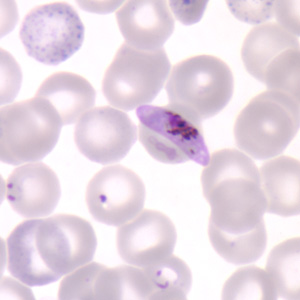
Plasmodium was placed in this specific kingdom because the characteristics of this organism are characteristics that are found in kingdom Prostista. For example, Plasmodium Falciparum is a eukaryotic organism that is unicellular. Any organism placed in this kingdom is usually a eukaryotic organism that is unicellular. Also, they are motile, have a nervous system. use asexual reproduction, use photosynthesis and absorption as a way to get nutrition [25].
Plasomodium Falciparum is a ringed shaped protozoan parasite that grows in tropical places in Africa and is about 1-2 microns big [26]. This bacteria is commonly known as one of the malaria parasites that can cause Malaria in humans. This Bacteria is responsible for 85% of the cases of Malaria and is known as the most dangerous version. Malaria can be transmitted through mosquitos that have the bacteria Plasmodium Falciparum. The way a person can be tested for the disease is by taking a blood test and if there is Plasmoduim Falciparum in the blood that person has malaria. Although, there are medications to help treat the bacteria [27].
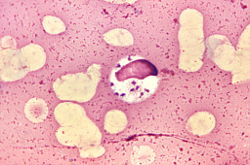
Leishmania Donovani is a part of the kingdom Protista due to the fact that this organism shares charactersitics that other organisms in this kingdom have. For example, all organisms in kingdom protista are eukaryotic and unicelluar. Leishmania Donovani is both a eukaryotic organism as well as unicelluar thus concluding why it is in this kingdom [28].
Leishmania Donovani is a spherically shaped bacteria that causes the disease, Leishmaniasis. Leishmaniasis is a disease that causes damaged, irritated skin in different areas of the body [29] [30]. This bacteria is most commonly found in India, China, Africa, Russia, and Southern Europe [30]. Leishmania Donovani can be transferred through sand flies. When these flies bite someone, they are transmitting the bacteria that will give them the disease [29].